
Turning a Mining Community Into Recurring Income
A mining community is not a list of sign-ups; it is a pool of hashrate that stays online. At difficulty 132.76 T, twenty 200 TH/s rigs represent 4 PH/s, produce about $151.97 of gross income a day, and generate roughly $6.08 a day of pool fee on the block-reward component alone — which is the number that recurs, not the number of people who joined.

Key takeaways
- Referral economics are second-order: they are derived from the fees a pool charges on referred hashrate, so the referred hashrate and its uptime set the ceiling.
- Twenty 200 TH/s rigs equal 4 PH/s, about $151.97 a day of gross mining income at a BTC price of $84,692, of which the listed 4% fee on the block-reward component is roughly $6.08 a day — about $182 a month.
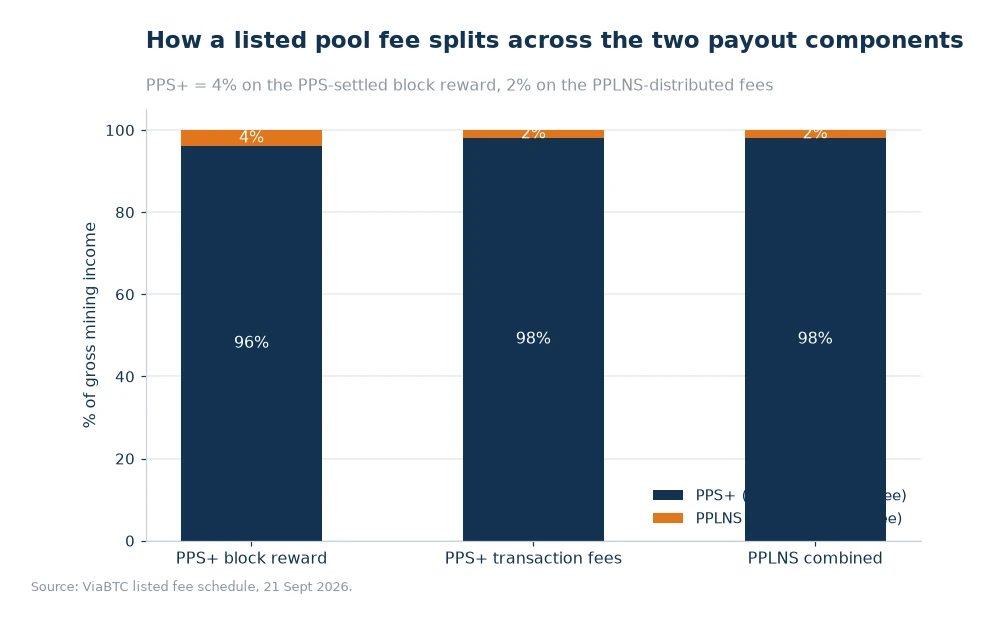
- The listed fee is not one rate: it is 4% on the PPS-settled block reward and 2% on the PPLNS-distributed transaction-fee component, so the mix of a referred miner's income changes the fee base.
- Churn is the real risk. A rig that is offline does not generate shares, and shares are what produce both the miner's payout and the fee revenue behind any referral programme.
Context in 2026
Mining is now an uptime business more than an entry business. Network hashrate is around 1,003 EH/s, difficulty sits at 132.76 T, and the network issues 450 BTC a day across 144 blocks. None of those figures reward enthusiasm; they reward machines that run continuously under a stable power contract and a pool connection that does not drop shares.
That changes what a community is worth. A referrer who brings in fifteen miners who stop after two months has collected a spike. A referrer who brings in five miners who run for two years has built a stream. Both look similar in a sign-up screenshot, and only one of them shows up in the arithmetic — because every payout a referred miner receives is a payout on which the pool earned a listed fee.
The multi-coin nature of a modern pool helps here. Support for twenty or more chains, including BTC, BCH, LTC/DOGE merged mining, KAS, ZEC, HNS, CKB and ETC, means a community's hardware can follow whichever chain is currently worth mining without the members changing operators. That reduces the most common cause of churn: a rig that becomes uneconomic on one asset.
The two variables that matter
The first variable is referred hashrate that stays online. Everything downstream — the miner's payout and any referral income derived from it — is a function of shares submitted. A 200 TH/s rig running at 95% uptime over a month submits about 5% less work than the same rig at 100%, and the loss compounds silently because the machine still draws full power.
The second variable is the composition of the income being generated, because the listed fee attaches to two different components. Under PPS+, which is the default, the block-reward component is settled per share at a listed 4% fee and the transaction-fee component is distributed with PPLNS logic at a listed 2% fee.[1] Under PPLNS, both components are distributed together at a listed 2% fee. A community concentrated on one coin and one payment method has a different fee base than one spread across several.
| Referred hashrate | Gross income per day | Fee on block-reward component (4%) | Per 30-day month |
|---|---|---|---|
| 20 TH/s — one small rig | $0.76 | $0.03 | $0.91 |
| 200 TH/s — one current rig | $7.60 | $0.30 | $9.12 |
| 2 PH/s — a small farm | $75.99 | $3.04 | $91.19 |
| 4 PH/s — twenty 200 TH/s rigs | $151.97 | $6.08 | $182.38 |
Two caveats keep this honest. First, the fee on the transaction-fee component is additional and is not included above, because its size varies with on-chain demand; the figures are therefore a floor rather than a total. Second, real fee revenue only arrives on hashrate that is actually connected, so the useful question is not "how many joined" but "how much referred hashrate was online in the last 24 hours".
Numbers from a real rig
Take a 200 TH/s machine as the unit. At 132.76 T it produces 0.00008972 BTC a day, which is $7.60 at $84,692. Net of the listed 4% fee that is $7.29. Its electricity at 20 J/TH is 4 kW, or 96 kWh a day — $5.76 at $0.06/kWh — so the operator's margin is roughly $1.53 a day before hosting or other costs.
That margin is what keeps the machine online, and the machine staying online is what produces the recurring fee. Now scale the same unit to a community of twenty: 4 PH/s of referred hashrate, $151.97 a day of gross income, and about $6.08 a day of listed fee on the block-reward component — $182 over a 30-day month. At 10% uptime loss across the group, the same community produces about $164 a month instead of $182.
That is the whole case for treating this as a retention project. A single 2 PH/s farm generates more fee in a week than a hundred one-off sign-ups that never connect — and unlike the sign-ups, it can be monitored. This is where the operating tools stop being decoration: a dashboard that reports per-worker hashrate turns churn into a signal you can act on, and a mining app with real-time hashrate monitoring and alerts turns a dead rig from a month-long silent loss into an overnight fix.
Decision guide
- Measure hashrate, not headcount. Track referred hashrate online per day. It is the only figure that maps to income and the only one that responds to support.
- Onboard with the payout route in mind. A referred miner whose coins land in an account with zero-fee mining payouts and a built-in multi-currency wallet has one less reason to leave, and one less chance to lose a small balance to transfer fees.
- Keep chains in reserve. When one asset's economics deteriorate, a community that can move hashrate on a mining pool without changing operators is far less likely to disperse.
- Check the terms on the source. Referral percentages, payout timing and eligibility are defined by the programme itself, not by any third-party summary; the terms for this pool are documented on the ViaBTC Referral page, which is the version that applies.
- Re-run the arithmetic quarterly. Referral income scales with referred gross income, which moves with both difficulty and price. A community that was worth $6 a day in September is worth a different figure after the next adjustment.
Frequently asked questions
How often should a miner check pool statistics?
Weekly is enough for cash flow, daily if you are reconciling worker uptime or chasing a hashrate fault.
Does the payout method change my average income?
It changes the variance and the fee, not the underlying expected value: your share of network hashrate still sets the ceiling.
Does referral income depend on the BTC price?
Yes, indirectly. Referral income is derived from fees charged on referred hashrate, and that hashrate's gross income moves with both the coin price and network difficulty. There is no fixed amount per sign-up; the recurring figure is set by referred hashrate that is online and the fee components it generates.
The short version
Build the community around uptime, not around invitations. Track referred hashrate online daily, make sure every member has a payout route that does not leak small balances, and keep an alternative chain available so a bad month does not become a permanent exit. At today's numbers a well-retained 4 PH/s community generates about $6 a day of fee on the block-reward component — modest per day, meaningful per year, and entirely dependent on the rigs still running next quarter.
Data and sources: ViaBTC pricing[1] and the ViaBTC fee breakdown[2]. Difficulty, network hashrate and the BTC price used in every calculation were read from public chain data and market feeds on 21 September 2026. Fee figures are derived by applying the listed percentages to calculated gross income and exclude the transaction-fee component; actual referral terms are defined by the programme itself.