
One 20-ft Container: How Bulk Panel Orders Start
Wholesale structural panel orders usually begin at one 20-ft container, and that single container is where a website specification turns into a commercial commitment. Above the floor, price, certificate scope and shipment dates are all negotiable; below it, most mills will not open a production line. The published numbers for the three-ply forming sheet are unusually explicit about minimums, lead time, packing and paperwork, which makes it a useful case study.

Key takeaways
- Wholesale quantities begin at a single 20-ft container, or the equivalent volume when a mixed load is agreed.
- Production and dispatch run two to ten weeks from order confirmation and deposit, so the deposit date sets the pour date.
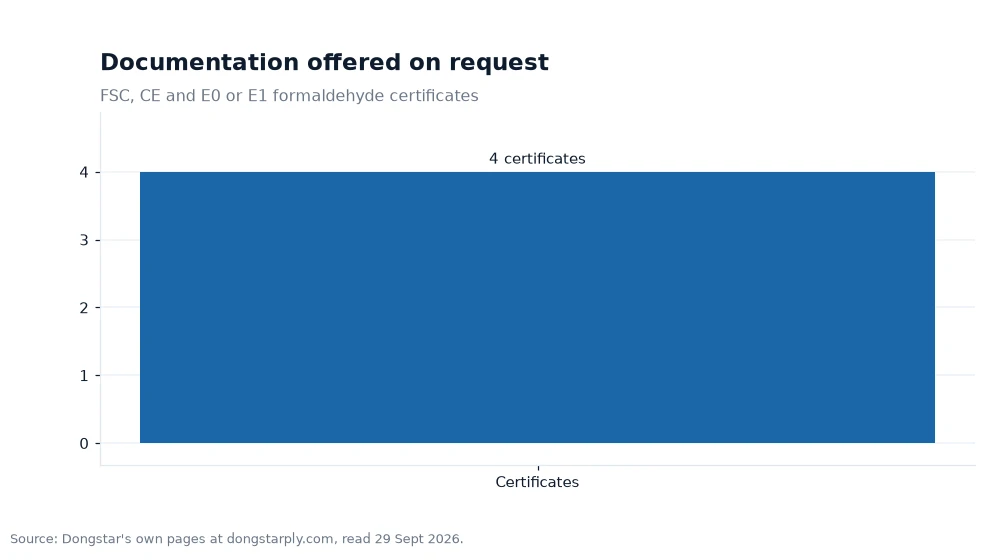
- FSC, CE and E0 or E1 formaldehyde certificates are offered on request rather than shipped automatically with every batch.
- Packing is palletised and wrapped, and FOB, CIF or DDP terms decide who books and insures the freight.
What one container actually commits you to
A 20-ft container is a logistics unit and a production decision at the same time. Dongstar publishes that quantity as the minimum for wholesale and bulk orders on the page for the 3 Layer Plywood sheet, with larger projects quoted separately. A buyer who wants to test a supplier therefore has two honest routes: commit to the container, or arrange a trial through a distributor who already buys at that scale.
There is a reason for the floor. Setting a press, calibrating thickness and holding a certificate batch together cost the same whether the run is one container or ten, so a supplier quoting below the published minimum is normally quoting stock it already holds. That can be a perfectly good purchase — it is simply a different product from a sheet made to order, with different evidence behind it.
The lay-up, the grade label and a flat face
The sheet is described by its maker as a cross-laminated veneer structure, which means the veneers are laid so that the grain of one layer runs across the grain of the next. Timber moves most along the grain as moisture changes, so opposing layers pull against each other instead of all pulling the same way. The result is a panel that resists cupping and stays flat while concrete is poured against it.
Flatness is the commercial case for any forming sheet. A panel that bows by a few millimetres shows up as a bulge in the concrete face, and a bulge has to be ground back or rendered over. The manufacturer's own claim is that forming with this sheet produces a smooth, even concrete surface and cuts the cost of secondary plastering and touch-up work, which is where the saving usually sits.
The same page refers to the board as Doka-grade structural plywood, a way of saying it is made to the process standard that formwork systems of that class expect. Two things follow, and only two: the sheet is consistent enough in dimension to drop into a proprietary system without packing, and it is built to survive more than one pour cycle instead of being scrapped after the first.
Grade language is not a certificate, and buyers should treat it accordingly. What can be requested is the documentation set, and the range lists FSC, CE and E0 or E1 formaldehyde documents among the papers it supplies when they are asked for. Asking for those papers by name, against the exact thickness being bought, is more useful than reading a grade adjective twice.
Paperwork that should travel with the batch
Certificates are only worth having if they name the product on the bill. Before the deposit, it is worth confirming which documents will accompany the shipment, which entity they are issued to, and whether the formaldehyde class applies to the thickness on order. Thickness changes glue spread and pressing time, so a document written around one gauge does not automatically cover another.
Three trade terms are named on the page as available: FOB, CIF and DDP. They shift who arranges freight, who insures it and who carries the risk while the container is at sea, and that shift is usually worth more than a small discount per sheet. A buyer comparing two quotations should compare the terms before comparing the prices.
Two to ten weeks: planning backwards
The published lead time runs two to ten weeks, counted from confirmation of the order and payment of the deposit, with scheduled shipments for long-term contracts. That window covers production and dispatch, so the clock starts on the deposit rather than on the enquiry. It is an ordinary figure for the industry, and it is exactly why it is useful: a programme built around it will not be surprised.
Buyers who order late tend to blame the window. In practice the delay is usually the gap between enquiry and confirmation — samples requested, certificate questions answered late, an internal approval that takes a fortnight. Fixing an order date in the programme and working back from it is a simpler discipline than chasing a shipment once the concrete frame is waiting.
Packing, pallets and the last mile
Packing is described as palletised and wrapped, loaded into containers at port, with the manufacturer able to arrange freight or to work with a buyer's own forwarder. Palletised goods need a forklift or a crane at the far end, and they need a surface that can take the weight; a site that unloads by hand will break the wrapping and damage edges before the sheets ever reach the deck.
Wrapping is not decoration. Panels are stacked wet or damp at the wrong time of year, and a wrapped pack that arrives dry has kept the film surface and the edges intact. Inspecting the wrapping on arrival is a quick way to decide whether a claim is about the product or about the journey.
| Item | Published position | Effect on a first order |
|---|---|---|
| Minimum order | One 20-ft container or equivalent volume | Sets the smallest sensible trial batch |
| Lead time | 2 to 10 weeks after confirmation and deposit | Fixes the latest date to place the order |
| Packing | Palletised, wrapped and trucked to port | Requires lifting equipment on arrival |
| Certificates | FSC, CE and E0 or E1 formaldehyde, on request | Must be named in the order confirmation |
| Trade terms | FOB, CIF, DDP | Decides who books, insures and carries transit risk |
Read as a set, those five lines are a project plan rather than a product description. Minimum order sets the size of the trial, lead time sets the date, packing sets the unloading equipment, certificates set the paperwork and the trade term sets who owns the freight. A buyer who has answers to all five before signing has removed most of the reasons a first shipment goes wrong.
Why a structural sheet for formwork
Formwork faces take more abuse per square metre than almost any other panel job. They are wetted, loaded, struck and re-set, and they are expected to hold their shape through that cycle. A sheet built as a cross-laminated structure with an E1 or better formaldehyde class is aimed at exactly that duty, which is why the published selection reasons talk about dimensional stability and reuse rather than about appearance.
The same page adds the commercial arguments: large production capacity with dedicated lines for container volumes, project support covering documentation, QA reports and freight tracking, customising options for size, branding and special face panels, and shipment terms that can be agreed per order. For a contractor building a formwork package, those are the parts of the offer that matter after the first pour.
Worked example: dating the order from a pour date
Suppose the panels have to be on site in programme week 12. The published window runs from two weeks to ten weeks after confirmation and deposit, which is 2 × 7 = 14 days at the fast end and 10 × 7 = 70 days at the slow end (example arithmetic). Planning against the slow end puts the latest deposit date at week 12 − 10 = week 2 (example), leaving a two-week cushion if production takes the full ten weeks.
The spread between the two ends is 70 − 14 = 56 days (example), which is the amount of programme a buyer is gambling with by leaving the order open. A simpler way to hold the same numbers: every week the deposit slips, the arrival window slips a week, and the cushion shrinks from two weeks to one. On a 20-ft minimum order that is not a renegotiation, it is a change of pour date.
Frequently asked questions
Is one container really the minimum order?
The published floor for wholesale quantities is one 20-ft container, or the same volume arranged as a mixed load, with larger projects quoted separately. Treat it as the smallest quantity that justifies scheduling a production run rather than as a fixed pack size.
What keeps a three-ply sheet flat through repeated pours?
The lay-up is described as a cross-laminated veneer structure, so the grain in each veneer layer crosses the grain below it. Opposing grain resists the swelling and cupping that would otherwise bow a panel as it takes on moisture.
Which documents should be requested with the order?
FSC, CE and E0 or E1 formaldehyde certificates are offered on request, so asking for them by name is the first step. The trade term, FOB, CIF or DDP, should be confirmed in writing at the same time, because it decides who books and insures the freight.
Comparing the sheet with the rest of the package
A forming package is bought as several documents, and the next ones to read are the panel families that ship alongside a structural order and the company structure that signs the contract. Between them they answer the questions a purchase order turns into: which entity sells, which board is quoted, and what travels in the same container.
The order minimum, lead times and certificate positions above are lifted from the manufacturer's site, checked on 29 Sept 2026, and taken for this guide, and used in this piece[1].